A total lunar eclipse is coming. What to know about the 'blood moon'

In the early morning hours of March 3, a totallunar eclipsewill pass over the United States.

USA TODAY

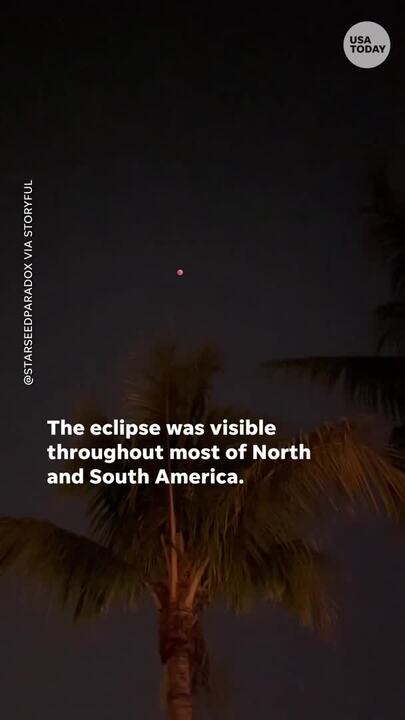
The "blood moon" eclipse will cause the moon to exhibit a reddish hue, according toNASA. It will be visible in parts of the world beginning in the evening and going into the early morning, NASA said.

Here's everything to know about the phenomenon as it approaches.

The Moon appears from behind the Tokyo Skytree during a total lunar eclipse in the middle of the night above the Japanese capital early on September 8, 2025. Stargazers enjoyed a The Moon appears at the very top of the Tokyo Skytree during a total lunar eclipse in the middle of the night above the Japanese capital early on September 8, 2025. The The A full moon, also known as the This photograph shows a full moon also known as People are seen on a floor of the Shanghai World Financial Centre as a full moon, also known as the A full moon is seen during a A full moon, also known as the A phase of a total eclipse of the moon is seen behind the Triumphal Chariot at the top of the Arch of the General Staff in Saint Petersburg on September 7, 2025. This photograph shows a view of a full moon also known as A full moon, also known as the Beach-goers rest on a shore of the Black Sea with a full moon also known as A jet flies past the full moon just after lunar eclipse in Frankfurt am Main, western Germany, on September 7, 2025. The Blood Moon is seen during a total lunar eclipse above the monument of the Gemidzhii in Skopje on September 8, 2025. People are seen on the Bund promenade along the Huangpu river as a full moon, also known as the Beach-goers rest on a shore of the Black Sea with a full moon also known as A combination picture shows the full moon moving through the shadow of the earth during a The moon appears during a lunar eclipse in the sky, behind the the Saladin Citadel, in Cairo, Egypt September 7, 2025. The Full Moon rises in the sky before a A full moon is seen during a A A full moon rises in the sky during a

See stunning images of the 2025 'Blood Moon' and total lunar eclipse

What is a total lunar eclipse?

A lunar eclipse occurs when the Earth passes between the sun and the moon, creating a shadow across the lunar surface, which turns the moon's color reddish-orange. Our planet blocks most of the sun's light from reaching the moon, but the Earth's movement during the eclipse will cause the natural satellite to develop a color.

The moon typically exhibits a grey color because light that reaches the lunar surface is often filtered through Earth's atmosphere.

It's only possible to observe an eclipse during a full moon phase, according to NASA. An eclipse can be observed from anywhere with a direct view of the natural satellite.

Where will the eclipse be visible?

The eclipse will be visible in eastern Asia and Australia in the evening and throughout the night in the Pacific. In the early morning, it will be visible in North and Central America, in addition to far western South America, NASA has said.

Advertisement

In central Asia and much of South America, the eclipse will only be partially visible. There will be no visibility in Africa or Europe.

What time will the eclipse be visible?

Stargazers can observe the eclipse on March 3 from 4 a.m. EST to around 7 a.m. EST, while a partial eclipse will continue until roughly 9 a.m. EST.

Anyone seeking more information on how to view the eclipse, stars and planets can visit NASA'sWhat's Up guide. Binoculars or a telescope are recommended for enhanced views, as is watching the eclipse from a dark environment away from bright lights.

What else is visible during an eclipse?

More:How to view the 2026 'Blood Moon' total lunar eclipse

An eclipse can also make stars and constellations more visible. During the upcoming eclipse, the moon will be in the constellation Leo under the lion's hind paws, according toNASA.

Venus and Saturn will also appear closer to each other in the night sky on March 8.

Michelle Del Rey is a trending news reporter at USA TODAY. Reach her at mdelrey@usatoday.com

This article originally appeared on USA TODAY:Total lunar eclipse is days away. What to know about the 'blood moon'

A total lunar eclipse is coming. What to know about the 'blood moon'

In the early morning hours of March 3, a totallunar eclipsewill pass over the United States. The "blood m...
A March Madness prelude: Men's basketball conference tournament schedule

Before theMadnessbegins, we need to crown conference champions andNCAA Tournamentautomatic bids are up for grabs.

USA TODAY Sports

Here's a list of themen's basketballconference tournament schedules:

Bracketology:NCAA Tournament last four in, first four out

March Madness predictions:13 teams who can win NCAA tournament

Men's college basketball conference tournament dates, schedule

Listed by start date.

Advertisement

  • Horizon: March 2-10 (Indianapolis)

  • Sun Belt: March 3-9 (Pensacola, Fla.)

  • Patriot: March 3-11 (on campus)

  • OVC: March 4-7 (Evansville, Ind.)

  • ASUN: March 4-8 (Jacksonville, Fla.)

  • Big South: March 4-8 (Johnson City, Tenn.)

  • Summit: March 4-8 (Sioux Falls, SD)

  • NEC: March 4-10 (on campus)

  • MVC: March 5-8 (St. Louis)

  • MAAC: March 5-10 (Atlantic City, NJ)

  • WCC: March 5-10 (Las Vegas)

  • SoCon: March 6-9 (Asheville, NC)

  • CAA: March 6-10 (Washington DC)

  • Big Sky: March 7-11 (Boise)

  • America East: March 7-14 (on campus)

  • Mountain West: March 7-14 (Las Vegas)

  • Southland: March 8-12 (Lake Charles, La.)

  • SWAC: March 9-14 (Atlanta)

  • ACC: March 10-14 (Charlotte)

  • Big 12: March 10-14 (Kansas City)

  • Conference USA: March 10-14 (Huntsville, Ala.)

  • Big Ten: March 10-15 (Chicago)

  • Big East: March 11-14 (New York City)

  • Big West: March 11-14 (Henderson, NV)

  • MAC: March 11-14 (Cleveland)

  • MEAC: March 11-14 (Norfolk, Va.)

  • WAC: March 11-14 (Las Vegas)

  • American: March 11-15 (Birmingham)

  • Atlantic 10: March 11-15 (Pittsburgh)

  • SEC: March 11-15 (Nashville)

  • Ivy: March 14-15 (Ithaca, NY)

When is Selection Sunday 2026?

The 68-team bracket for the 2026 NCAA men's basketball tournament will be unveiled on 6 p.m. ET, Sunday, March 15.

When does March Madness start?

The first men's game of the 2026 NCAA tournament will be on March 17 with the start of the First Four in Dayton, Ohio.

March Madness 2026 schedule

The 2026 NCAA men's basketball tournament will transpire over the next three weeks, which will end with the Final Four and the national championship game in Indianapolis.

Here's a rundown of the schedule for the 2026 NCAA Tournament:

  • First Four: March 17-18

  • First round: March 19-20

  • Second round: March 21-22

  • Sweet 16: March 26-27

  • Elite Eight: March 28-29

  • Final Four: April 4 at Lucas Oil Stadium in Indianapolis

  • National championship game: April 6 at Lucas Oil Stadium in Indianapolis

This article originally appeared on USA TODAY:NCAA men's basketball conference tournament schedule, dates, locations

A March Madness prelude: Men's basketball conference tournament schedule

Before theMadnessbegins, we need to crown conference champions andNCAA Tournamentautomatic bids are up for grabs. ...
Zimbabwe wins toss and opts to bat against South Africa in Super 8 matchup at T20 World Cup

DELHI, India (AP) — Sikandar Raza won the toss and Zimbabwe opted to bat against South Africa in their final Super 8 game at the 2026T20 World Cupon Sunday.

Associated Press Zimbabwe supporters cheer with their national flag before the start of the T20 World Cup cricket match between South Africa and Zimbabwe in New Delhi, India, Sunday, March 1, 2026. (AP Photo/Manish Swarup) T20 World Cup trophy is being displayed before the start of the cricket match between South Africa and Zimbabwe in New Delhi, India, Sunday, March 1, 2026. (AP Photo/Manish Swarup)

South Africa and Zimbabwe T20 WCup Cricket

South Africa has already qualified for the semifinals from Group 1, while Zimbabwe has been knocked out after two successive losses.

Co-host and defending champion India will battle against the West Indies later on Sunday in Kolkata for the second semifinal spot from this group.

England and New Zealand have qualified for the semifinals from Group 2. Pakistan and co-hosts Sri Lanka were knocked out.

Zimbabwe has made one change to its line-up with wrist spinner Graeme Cremer coming back into the side for medium pacer Richard Ngarava.

South Africa, the only unbeaten team in the tournament, has opted to test its bench strength ahead of the semifinal and made three changes.

Pacers Kewna Maphaka and Anrich Nortje, along with all-rounder George Linde, get a game. Left-arm spinner Keshav Maharaj along with pacers Marco Jansen and Kagiso Rabada have been rested.

Advertisement

The pitch at the Arun Jaitley Stadium in Delhi should aid batters and a high-scoring game could be in the offing.

Zimbabwe: Tadiwanashe Marumani, Brian Bennett, Dion Myers, Sikandar Raza (captain), Ryan Burl, Tony Munyonga, Clive Madande, Brad Evans, Wellington Masakadza, Graeme Cremer, Blessing Muzarabani

South Africa: Aiden Markram (captain), Quinton de Kock, Ryan Rickelton, Dewald Brevis, David Miller, Tristan Stubbs, George Linde, Corbin Bosch, Anrich Nortje, Kwena Maphaka, Lungi Ngidi

AP cricket:https://apnews.com/hub/cricket

Zimbabwe wins toss and opts to bat against South Africa in Super 8 matchup at T20 World Cup

DELHI, India (AP) — Sikandar Raza won the toss and Zimbabwe opted to bat against South Africa in their final Super 8 game...
OPEC+ debates oil output boost as US war on Iran disrupts shipments

By Olesya Astakhova, Alex Lawler and Ahmad Ghaddar

Reuters

LONDON/MOSCOW, March 1 (Reuters) - OPEC+ will consider a larger-than-expected oil output increase on Sunday, two OPEC+ sources said after ‌the U.S.-Israeli war on OPEC+ member Iran and Tehran's retaliation led to shipment ‌disruptions in the Middle East.

OPEC+ has a history of raising oil output to cushion disruptions but analysts said the ​group currently has very little spare capacity to meaningfully add to supply, except for its leader Saudi Arabia and the United Arab Emirates.

Riyadh has been raising oil production and exports in recent weeks in preparation for U.S. strikes on Iran, sources have told Reuters.

Oil, gas and other shipments ‌from the Middle East via the ⁠Strait of Hormuz have come to a halt since Saturday after shipowners received a warning from Iran saying the area was closed for navigation.

OPEC+ ⁠will debate a production hike of 411,000 barrels per day or more at a meeting on Sunday, sources told Reuters, larger than the original expectations of 137,000 bpd.

Advertisement

Oil prices jumped on Friday ​to $73 per ​barrel, the highest level since July, on fears ​of a wider conflict in the ‌Middle East and supply disruptions through Hormuz, the world's most important oil route amounting to over 20% of global oil transit.

Middle East leaders have warned Washington that a war on Iran could lead to oil prices jumping to over $100 per barrel, said veteran OPEC analyst Helima Croft from RBC. Analysts from Barclays also said prices could rise to $100.

Croft said the market impact ‌from any large OPEC output increase will be limited ​due to a lack of actual production capabilities outside ​Saudi Arabia.

The meeting on Sunday will ​start at 1100 GMT and will involve only eight members of OPEC+ - ‌Saudi Arabia, Russia, the UAE, Kazakhstan, Kuwait, ​Iraq, Algeria and Oman. ​OPEC+ groups the Organization of the Petroleum Exporting Countries and allies like Russia but most production changes in the past years have been done by the eight members.

The ​eight members raised production quotas ‌by about 2.9 million bpd from April through December 2025, roughly 3% of ​global demand, before pausing increases for January to March 2026 due to seasonal ​weakness.

(Writing by Dmitry Zhdannikov; Editing by Emelia Sithole-Matarise)

OPEC+ debates oil output boost as US war on Iran disrupts shipments

By Olesya Astakhova, Alex Lawler and Ahmad Ghaddar LONDON/MOSCOW, March 1 (Reuters) - OPEC+ will consider a la...
What we know about the death of Iranian supreme leader Khamenei

Ayatollah Ali Khamenei, Iran's hardline supreme leader who ruled the country for almost four decades, was killed in Saturday's joint US-Israeli strikes, Iranian state media confirmed Sunday, prompting celebration among Iranians who opposed his rule and fury from pro-regime loyalists.

CNN Iran's supreme leader, Ayatollah Ali Khamenei, speaks during a mourning ceremony for the deaths of Iranian military commanders and scientists, who were killed in Iran's 12-day war with Israel, in Tehran onJuly 29, 2025. - Office of the Iranian Supreme Leader/Wana News Agency/Reuters

An Iranian TV broadcaster broke down in tears as he confirmed Khamenei had reached "martyrdom" in a strike that Fars New Agency said hit his compound in Tehran as he was "carrying out his duties."

The death of the cleric who repressed millions as he sought to exert Iran's influence in the Middle East and beyond appears likely to plunge the Islamic Republic into the most serious crisis since its establishment, with no clear leader to take his place.

One of Iran's most powerful figures, Ali Larijani, Secretary of the Supreme National Security Council, signaled Iran's defiance on Sunday, vowing to "stab" America in the heart in retaliation.

Here's what we know:

How did he die?

Satellite images from Airbusshowedblack smoke rising from the supreme leader's compound in the capital, Tehran, on Saturday. The images appeared to show that several buildings in the compound had been severely damaged by strikes.

Initially, Iran's Foreign Ministry hadinsistedthat Khamenei was "safe and sound," even as his death was announced by both US President Donald Trump and Israeli Prime Minister Benjamin Netanyahu.

"There are many signs" that Iran's supreme leader is "no longer with us," Netanyahu had said Saturday evening, without elaborating.

Smoke billows above the compound of Ayatollah Ali Khamenei in Tehran on Saturday, February 28. - Airbus

Two Israeli sources told CNN that the strikes targeted senior figures, including Khamenei, President Masoud Pezeshkian, and the armed forces' chief of staff Abdolrahim Mousavi.

Trump said one of the aims of the joint US-Israeli attack was regime change, and he called on the Iranian people to rise up against the government.

However, it was unclear whether such change would result from Khamenei's death, which appeared likely to usher in hard-line rule by the Islamic Revolutionary Guard Corps, experts said.

What led to this?

Khamenei's death comes at a time when Iran is arguably at its weakest since he took power in the 1989. Decades of Western sanctions had already left the country isolated and economically battered before US and Israeli strikes in June 2025 dealt his rule a severe blow.

Just six months later, protests that began over economic grievances quickly turned political, spreading across all 31 of the country's provinces within weeks. The regime responded with a brutal crackdown, killing thousands of protesters and prompting a global outcry, including a threat of intervention from the Trump administration.

That intervention came on Saturday, when Trump said the US military was undertaking a "massive and ongoing operation to prevent this very wicked, radical dictatorship from threatening America and our core national security interests."

President Donald Trump monitors US military operations in Iran, February 28, 2026. Portions of the photo have been blurred by the White House. - The White House/X

Who could replace Khamenei?

Larijani, who been a key adviser to Khamenei, said a temporary leadership structure comprising of the president, the head of the judiciary would soon be in place.

Larijani said Iran had assured leaders in the region that it was not after war with them, but would continue to targeted American bases in Middle Eastern countries.

Advertisement

"It must be made clear once and for all that the Americans cannot bully the Iranian nation," he said.

According to Iran's constitution, an interim three-member council — consisting of the president, the head of the judiciary and a jurist of the country's Guardian Council — would be tasked with carrying out the duties of the leader, until an Assembly of Experts appointed a new supreme leader, according to theMiddle East Institute.

Who could lead Iran next remains a mystery, even to those who have removed him. In January, US Secretary of State Marco Rubio said that "no one knows" who would take over if Khamenei was removed.

Reza Pahlavi, the eldest son of Mohammad Reza Pahlavi, the last shah of Iran, said any attempt to appoint a successor to Khamenei "is doomed to fail from the outset."

How are Iranians reacting?

Cheering could be heard in Tehran as news spread about Khamenei's demise, but as morning broke on Sunday, thousands of people gathered in the capital to wave flags and chant "Death to America."

For protesters who fought for regime change in protests across the country this January, prompting a brutal crackdown, Khamenei needed to go.

The regime employed unprecedented levels of violence, with officials framing the demonstrations as a continuation of an Israeli-American conspiracy against the Islamic Republic.

The protests were the biggest since thedeath of 22-year-old Mahsa Aminiwhile in the custody of the religious police in 2022.

Iranian demonstrators protest the US-Israeli strikes, in Tehran on Saturday. - Majid Asgaripour/WANA/Reuters

In one video obtained by CNN from an eyewitness in Tehran on Saturday as reports of Khamenei's death circulated, the voices of two women can be heard chanting, "Death to the Islamic Republic" and "Long Live the shah," in Farsi, before cheers and whistles erupt.

In a similar video, cheers are heard echoing across a residential neighborhood in the city. In cities around the world, members of the Iranian community took to the streets to celebrate a new era in Iran.

How could this impact the wider Middle East?

Khamenei's death has the potential to trigger the greatest shift in regional dynamics since the Hamas-led attack on Israel on October 7, 2023, after which Israeli Prime Minister Benjamin Netanyahu launched a sweeping campaign to eliminate actors hostile to his country across the Middle East — including Iran and its regional proxies.

It's the second time in less than a century that the United States has acted to remove an Iranian leader from power. In 1953, Mohammad Mossadegh, a secular, democratically elected prime minister, was overthrown in an Iranian army coup backed by the CIA and British intelligence after he nationalized the country's oil industry.

Iran's supreme leader, Ayatollah Ali Khamenei, arrives to cast his vote during parliamentary elections in Tehran on March 1, 2024. - Majid Asgaripour/Wana News Agency/Reuters

That event restored Shah Mohammad Reza Pahlavi to the throne and, after the monarch was deposed in the 1979 Islamic revolution, played a central role in the Islamic Republic's anti-US narrative. It regularly cited by Khamenei as a symbol of US imperialism and the reason for his distrust of the West.

Iran is home to a diverse population of more than 90 million, including Persians, Azeris, Arabs, Baloch and Kurds. Under Khamenei's decades-long rule, the Islamic Republic largely managed to contain civil and ethnic unrest.

But with no clear successor, his death would raise serious concerns about the stability of Iran, as well as the wider region, with potential consequences for the global economy.

For more CNN news and newsletters create an account atCNN.com

What we know about the death of Iranian supreme leader Khamenei

Ayatollah Ali Khamenei, Iran's hardline supreme leader who ruled the country for almost four decades, was killed in S...
More strikes aimed at Iran after Khamenei's death, Trump issues new warning

By Alexander Cornwell, Sarah El Safty, Yomna Ehab and Elwely Elwelly

Reuters People react as they gather at the Enghelab Square, after Iran's Supreme Leader Ayatollah Ali Khamenei was killed in Israeli and U.S. strikes on Saturday, in Tehran, Iran, March 1, 2026. Majid Asgaripour/WANA (West Asia News Agency) via REUTERS A woman reacts as people gather at the Enghelab Square, after Iran's Supreme Leader Ayatollah Ali Khamenei was killed in Israeli and U.S. strikes on Saturday, in Tehran, Iran, March 1, 2026. Majid Asgaripour/WANA (West Asia News Agency) via REUTERS People react as they gather at the Enghelab Square, after Iran's Supreme Leader Ayatollah Ali Khamenei was killed in Israeli and U.S. strikes on Saturday, in Tehran, Iran, March 1, 2026. Majid Asgaripour/WANA (West Asia News Agency) via REUTERS A woman holds on to a picture of Iran's Supreme Leader Ayatollah Ali Khamenei at the Enghelab Square, after he was killed in Israeli and U.S. strikes on Saturday, in Tehran, Iran, March 1, 2026. Majid Asgaripour/WANA (West Asia News Agency) via REUTERS People react as they gather at the Enghelab Square, after Iran's Supreme Leader Ayatollah Ali Khamenei was killed in Israeli and U.S. strikes on Saturday, in Tehran, Iran, March 1, 2026. Majid Asgaripour/WANA (West Asia News Agency) via REUTERS People carry a large Iranian flag as they gather after Iran's Supreme Leader Ayatollah Ali Khamenei was killed in Israeli and U.S. strikes on Saturday, in Tehran, Iran, March 1, 2026. Majid Asgaripour/WANA (West Asia News Agency) via REUTERS A man holds up a picture of Iran's Supreme Leader Ayatollah Ali Khamenei as people gather after Khamenei was killed in Israeli and U.S. strikes on Saturday, in Tehran, Iran, March 1, 2026. Majid Asgaripour/WANA (West Asia News Agency) via REUTERS

Iran's Supreme Leader Ayatollah Ali Khamenei killed in Israeli and U.S. strikes

TEL AVIV/DUBAI, March 1 (Reuters) - Israel said on Sunday it launched another wave of attacks on Iran, as Iranians grappled with uncertainty after the killing of their supreme leader in U.S. and Israeli strikes, while President Donald Trump warned of consequences for retaliation.

Hours after both nations said an air strike killed Ayatollah Ali Khamenei in the military ‌campaign to overthrow the government of the Islamic Republic, its state media confirmed the 86-year-old leader's death on Saturday.

In another blow for Iran's leaders, Armed Forces Chief of Staff Abdolrahim Mousavi was killed in strikes, broadcaster ‌Iran TV said.

The United States will hit Iran "with a force that has never been seen before," Trump warned on Sunday, if the Middle East nation hit back after the strikes.

"Iran just stated that they are going to hit very hard today, harder than they have ever been hit before," Trump ​said in a post on Truth Social.

He added, "THEY BETTER NOT DO THAT, HOWEVER, BECAUSE IF THEY DO, WE WILL HIT THEM WITH A FORCE THAT HAS NEVER BEEN SEEN BEFORE!"

Iran's top security official, Ali Larijani, said a temporary leadership council would be set up.

He accused the United States and Israel of trying to plunder and disintegrate Iran and warned "secessionist groups" of a harsh response if they attempt action, state television said.

In remarks directed at Trump and his close ally, Israeli Prime Minister Benjamin Netanyahu, Iran's parliament speaker, Mohammad Baqer Qalibaf, said they had crossed a red line and would "pay for it".

A source briefed on the Israeli campaign told Reuters there had been no change in military strategy after the killing of Khamenei and that strikes would continue to target ‌Iranian officials and missile infrastructure.

SECOND DAY OF LOUD BLASTS HEARD

Several loud blasts were heard ⁠for a second day on Sunday in regional business hub Dubai and over Qatar's capital of Doha, witnesses said, after Iran launched retaliatory strikes on the neighbouring Gulf states.

Puffs of white smoke from missile interceptions were glimpsed in the skies over Dubai, while billows of dark smoke rose over its port of Jebel Ali, one of the busiest in the Middle East.

Iran, which has ⁠said it would target U.S. bases if attacked, hit a range of other targets, keeping the major oil-producing Gulf on edge.

Air raid sirens sounded repeatedly across Israel early on Sunday, with a series of explosions heard in Tel Aviv as Israel's sophisticated air defense system sought to intercept the latest Iranian offensive.

There was no immediate report of damage or injuries.

Trump said the air strikes aimed to end a decades-long threat from Iran and ensure it could not develop a nuclear weapon.

He sought to justify a risky gambit that seemed to ​contradict ​his professed opposition to American involvement in complex overseas conflicts.

Advertisement

"This is not only Justice for the people of Iran, but for all Great ​Americans, and those people from many Countries throughout the World, that have been killed or mutilated ‌by Khamenei and his gang of bloodthirsty THUGS," Trump wrote on Truth Social.

Trump and Netanyahu told Iranians to pursue a rare chance to topple their clerical leaders.

LEADERS ALREADY FACED PRESSURE ON SEVERAL FRONTS

The leadership had already been under pressure from an economy hammered by sanctions, protesters who proved ready again to take to the streets despite fierce crackdowns and regional proxies severely weakened by Israeli attacks.

Israel and the United States timed the attacks to coincide with a meeting of Khamenei and his top aides, said two U.S. sources and a U.S. official familiar with the matter.

Khamenei was working in his office at the time of Saturday's attack, state media said. It also killed his daughter, grandchild, daughter-in-law and son-in-law.

Experts said that while the deaths of Khamenei and other Iranian leaders would deal the country a major blow, it would not necessarily spell the end of Iran's entrenched clerical rule or the sway of the elite Islamic Revolutionary Guards Corps over the population.

Trump evoked the 1979 ‌storming of the U.S. embassy in Tehran, when Iranian student activists in coordination with radical clerics took 52 American hostage for 444 days, demanding ​the extradition of the deposed Shah from the United States.

Israel's military said it targeted Iran's ballistic missile and air defense systems with strikes on ​Sunday morning.

Iran's armed forces would soon retaliate again with their biggest offensive against U.S. bases and Israel, the ​Revolutionary Guards vowed in a statement on Sunday.

Iran responded to Saturday's initial attacks by launching hundreds of missiles and drones targeting U.S. troops and cities in Israel and Arab countries allied with ‌Washington, prompting widespread cancellations of Middle East flights.

The Pentagon said there were no U.S. deaths ​or injuries.

ONE OF GLOBAL AVIATION'S WORST DISRUPTIONS

Major Middle Eastern airports, including ​Dubai, the world's busiest international travel hub, were shut on Saturday after Iran's missile retaliation unleashed one of global aviation's most severe disruptions in years.

Dubai's landmark Burj Al Arab hotel and the airport, which handles more than 1,000 flights a day, were damaged in an overnight attack on sites across the Arab Gulf states that also hit airports in Abu Dhabi and Kuwait.

On Saturday, Tehran warned that it had closed the Strait of Hormuz, ​the narrow conduit for about a fifth of global oil consumption, raising expectations of a ‌sharp jump in oil prices.

The OPEC+ grouping of major oil producers is set to meet on Sunday and may consider a larger-than-planned output increase as several tanker owners, oil majors and trading houses suspended ​energy shipments through the Strait.

After Israel pounded Iran in a 12-day air war in June, joined by the United States, both warned they would strike again if Tehran persisted with nuclear and ballistic missile ​programs.

(Reporting by Reuters bureaux; Writing by Simon Lewis, Clarence Fernandez and Michael Georgy; Editing by Sergio Non and Raju Gopalakrishnan)

More strikes aimed at Iran after Khamenei's death, Trump issues new warning

By Alexander Cornwell, Sarah El Safty, Yomna Ehab and Elwely Elwelly Iran's Supreme Leader Ayatollah ...

 

VIAS MAG © 2015 | Distributed By My Blogger Themes | Designed By Templateism.com